Made with Love

3D printed parts, unbelievable

Bubba said:
If you can't touch them, what's the point?.

Prim0 said:
As much as immature people like to doodle, how long before there's a site dedicated to 3d pen drawn dickbutts?

1370353336431.jpg

We can play 3D tic tac toe and hangman.
 
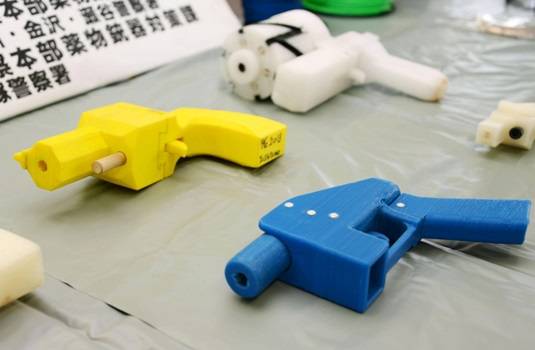
Yoshitomo Imura, an employee of Shonan Institute of Technology in Fujisawa, made the guns using a 3D printer he bought online for ¥60,000 ($590) and plans downloaded from file-sharing sites. He posted video online showing off his printing skills, and promptly got his collar felt by local police.

"I produced the guns, but I didn't think it was illegal," Imura said, Japan Timesreports. "I can't complain about the arrest if the police regard them as real guns."

While the police didn't find any bullets for the resin armaments, they are treating the matter very seriously. Japan has some of the strictest gun laws in the world – firing an unlicensed firearm will get you a sentence of between three years and life in prison, and getting a license requires a mental health assessment from a doctor, a drug test, a clean record, and a tricky safety test.

Japanese police are armed, but crack down on any gun violations severely, even in their own ranks. A few years ago a Japanese police officer used his service weapon to kill himself and was posthumously charged and convicted with breaking gun regulations. Even the local Yakusa gangsters eschew guns when possible.


As a result, Japan has some of the lowest rates of gun death in the world, with around 0.06 firearms fatalities per 100,000 people. Here in the Land of the Free, where pretty much anyone can own a gun with minimal oversight or training, that figure is 10.2 deaths per 100,000 people.

In Imura's case there was no suggestion he was planning to go on a killing spree with his 3D printed creations, and even if he did the chances are he'd be more likely to injure himself rather than anyone else.

While 3D-printed guns have been in circulation ever since a US hobbyist printed theLiberator handgun last year, they aren't exactly what you'd call a useful firearm – asEl Reg's own armaments specialist pointed out at the time. Attempts to make a 3D printed rifle were even less successful after the barrel split the first time it was fired.


The fact of the matter is it's almost impossible to make a useful firearm out of the kind of resin commonly used in 3D printers. A US firm has 3D printed a handgun out of metal – and it proved more accurate than a machined firearm – but the cost of both the metal printer and the afterwork needed makes them prohibitively expensive.


Regulators across the world are nevertheless cracking down on the design and production of 3D-printed weaponry, and the hapless Imura looks likely to be spending a significant amount of time behind bars as a result of his printing shenanigans. ®

3d_printed_guns.jpg


https://www.theregister.co.uk/2014/05/08/japanese_cops_arrest_man_with_five_3d_printed_guns_at_home/
 
Too cool.

At the International Manufacturing Technology Show in Chicago, Local Motors 3D printed a plastic car called the Strati in front of thousands of attendees.
Local Motors took the chassis, seats, door panels, and thousands of other components, and 3D printed all those parts into just one piece. The first phase of the process, completed on Tuesday, took just 44 hours.

"A 3D printed car like ours will only have dozens of components," Local Motors engineer James Earle tells Business Insider. In the near future, he says, it could cost only about $7,000 to manufacture, perhaps the start of what will become a niche market for customized cars.


"You can make a vehicle for yourself that's basically a one-0ff, do the entire design," he says. "You could create custom-fit seats that conform to your shape, things like that, that you couldn't do with cars now."


https://www.businessinsider.com/3d-printed-car-2014-9
 
Astronauts on the International Space Station have used their 3-D printer to make a wrench from instructions sent up in an email.

_79838255_125a2497b.jpg


It is the first time hardware has been "emailed" to space.

Nasa was responding to a request by ISS commander Barry Wilmore for a ratcheting socket wrench.

Previously, if astronauts requested a specific item they could have waited months for it to be flown up on one of the regular supply flights.

Mike Chen, founder of Made In Space, the company behind the 3-D printer, said: "We had overheard ISS Commander Barry Wilmore (who goes by "Butch") mention over the radio that he needed one, so we designed one in CAD and sent it up to him faster than a rocket ever could have."

Mr Wilmore installed the printer on the ISS on 17 November. On 25 November he used the machine to fabricate its first object, a replacement part for the printer.

Nasa says the capability will help astronauts be more self-reliant on future long duration space missions.

Mike Chen added: "The socket wrench we just manufactured is the first object we designed on the ground and sent digitally to space, on the fly.

"It also marks the end of our first experiment—a sequence of 21 prints that together make up the first tools and objects ever manufactured off the surface of the Earth."

The other 21 objects were designed before the 3D printer was shipped to the space station in September on a SpaceX Dragon supply flight.

https://www.bbc.com/news/science-environment-30549341
 
escapefromstress said:
Astronauts on the International Space Station have used their 3-D printer to make a wrench from instructions sent up in an email.

_79838255_125a2497b.jpg


It is the first time hardware has been "emailed" to space.

Nasa was responding to a request by ISS commander Barry Wilmore for a ratcheting socket wrench.

Previously, if astronauts requested a specific item they could have waited months for it to be flown up on one of the regular supply flights.

Mike Chen, founder of Made In Space, the company behind the 3-D printer, said: "We had overheard ISS Commander Barry Wilmore (who goes by "Butch") mention over the radio that he needed one, so we designed one in CAD and sent it up to him faster than a rocket ever could have."

Mr Wilmore installed the printer on the ISS on 17 November. On 25 November he used the machine to fabricate its first object, a replacement part for the printer.

Nasa says the capability will help astronauts be more self-reliant on future long duration space missions.

Mike Chen added: "The socket wrench we just manufactured is the first object we designed on the ground and sent digitally to space, on the fly.

"It also marks the end of our first experiment—a sequence of 21 prints that together make up the first tools and objects ever manufactured off the surface of the Earth."

The other 21 objects were designed before the 3D printer was shipped to the space station in September on a SpaceX Dragon supply flight.

https://www.bbc.com/news/science-environment-30549341

Impressive.
 
Big Delta: World’s largest 3D printer can build entire house out of mud or clay


The world’s largest 3D printer called Big Delta can now make entire houses out of clay.

WASP unveiled the world’s largest 3D printer which could provide a solution to housing shortages by creating low cost and eco-friendly houses made of clay and mud.

The 3D printing technology is getting bigger day by day. Now, the 3D printing design team at an Italian collective known as “WASP”, acronym for World’s Advanced Saving Project, have officially unveiled a 3D printer by presenting a live demonstration of the huge device at a three day rally event held in Italy which was also marked with a series of workshops and conferences.

The massive 3D printer is termed as “Big Delta” and the makers of this device claim that with 40 foot height and 20 foot in diameter, it is the world’s largest 3D printer. In addition, it is even capable of creating budget friendly clay and mud houses in just one continuous printing session.

Despite being so huge, Big Delta uses only 100 watts of power and hence it is extremely energy efficient.

It is the behemoth size of Big Delta, which enables the device to print economic houses with ease and speed.

WASP team takes its inspiration from the traditional construction methods such as those of clay and mud houses.

Big Delta is a beautiful combination of new technologies as well as ancient building techniques and it more or less emphasizes on the use of natural and eco-friendly materials for housing purposes.

According to the figures cited by the United Nations, it is estimated that by 2030 around 4 billion people who have their annual income below US $3,000 would be in need of low cost houses.

More here: https://www.techworm.net/2015/09/bi...an-build-entire-house-out-of-mud-or-clay.html
 
The world’s largest 3D printer called Big Delta can now make entire houses out of clay.


:writing::writing:
 
[h=1]This 3D-Printed Prosthetic Costs Way Less Than Alternatives[/h]
 
Back
Top Bottom