part 2
Descendant companies: Innovage, The Smart Circle, Cydcor etc.
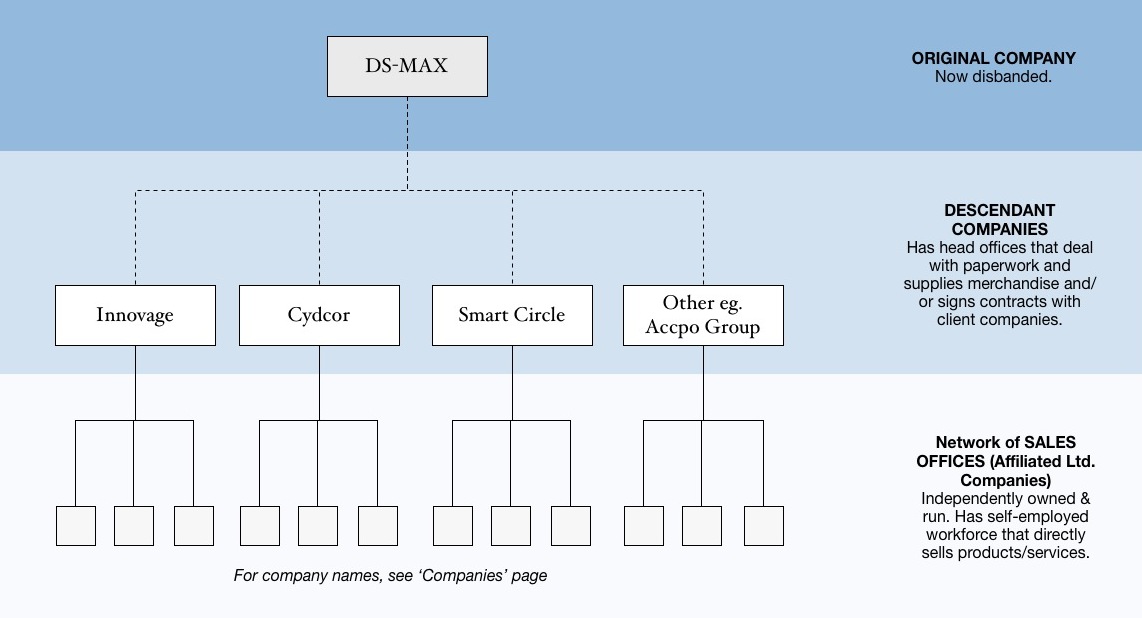
In 2005, due to negative publicity, the DS-Max organisation divided into its descendant companies. All direct connections with DS-Max have been severed, and the ‘DS-Max’ moniker removed from all company names. Instead, each division now promotes their own identity.
The Clearance Division spun off and became . The company purchases “millions of pieces of merchandise from partners like Disney, Warner Brothers and Vivitar” from thousands of factories, sourced by .
[9]
The Advertising Division became , renamed
The Smart Circle International in 2005. The Smart Circle still deals primarily with coupons from contracts with restaurants, fitness clubs, professional sports teams, auto body shops, hotels, golf courses and others. Clients include Domino’s Pizza, Hilton Hotels, The New York Yankees and Miami Heat.
[10]
The Communications Division became
Cydcor. Cydcor still signs up customers for monthly services. They serve clients across North America, including ATT, Sprint, Visa, MasterCard, CSI, DTV, Optus and many others.
[11]
Another notable mention is the Appco Group (
The Cobra Group), a Sydney offshoot founded by an employee of DS-Max in 1980s, Chris Niarchos. It is now primarily based in the UK. The Appco Group is a “billion-dollar group of diversified companies” with “more than 800 offices in 26 countries on five continents”.
[12] Clients include npower, Sky, British Red Cross, American Express and Coca-Cola.
Murray Reinhart has retired from the business but occasionally delivers motivational speeches at conventions.
[13]
The DS-Max Business Model
Each descendant company of DS-Max has a loose confederation of international sales offices.
Each sales office is an independently owned and operated limited company, legally bound to the descendant company only through a marketing contract. Therefore the DS-Max descendant companies remain insulated from any legal or financial liability, making guidelines on ethical conduct difficult to enforce.
Recruiting is done in the name of the affiliated limited company and any discredited company names are immediately changed. This makes it difficult to establish a connection between the independent sales offices and a descendant company, as well as challenging for prospective employees to discover bad press. However, similarities in
business practices often indicate an affiliation with a DS-Max descendant company.
Suppliers, such as Innovage, supply merchandise to their sales offices. Innovage employees coordinate shipping and storing of products. Sales and marketing companies, including Accpo Group, The Smart Smile and Cydcor, are ‘Listers’. Their employees find client leads for their sales offices. Clients such as AT&T sign a marketing contract with a reputable descendant company, which in turn outsources the contract to an affiliated sales company. All main offices of these descendant companies also process paperwork, admin, bookkeeping and some legal expenses. All affiliated companies pay their descendant company a set fee for this work, plus a cut of their profits in exchange for access to their clients and/or merchandise.
A different kind of MLM
The DS-Max Marketing Scheme classifies as multi-level marketing since products are directly sold to the customer. It does
not, however, classify as an illegal pyramid scheme since profits are not made from participation fees.
[14] There are several key differences that set it apart from other multi-level marketing businesses:
[15]
- All members begin as a Field Representative. Their income is completely commission based (rather than a slow transition from part-time to full-time). Members work for 12 or more hours a day, often 6 days a week, and must pay for all expenses since they are ‘self employed’ independent contractors. They are not officially associated with the company yet form their cost-free workforce. Only a small group of Vice-Presidents (now called National Consultants) have achieved the high levels of success that is promoted during the initial recruitment process.
- The Manager of a sales office is financially and legally responsible for their limited company and handles day-to-day office and recruitment expenses. The independent office would typically have one room for members, room(s) for the manager(s), a reception, a waiting room and a room where merchandise (if any) is stored under lock and key. It is not unknown to have multiple managers running different campaigns sharing the same office and splitting the rent.
A simple formula means the network of these affiliated companies grows exponentially. One company helps a member set up their own independent limited company, which eventually generates a new manager that in turn sets up their own company – ad infinitum. The descendant company then compensates the Manager of the first company for half of their workforce moving to a new office.
- For products, distributors receive the goods on consignment, thus the distributor does not pay for them up front. Distributors of services only receive their full commission once an application has been approved. There is no fee for becoming a distributor. This was the payment system for the AT&T campaign in 2000. AT&T paid $10 (~£6) for each customer that the field representative signed up. The parent company took $3, the manager of the affiliate company took $3 and the field representative took the remaining $4.[16] If the application didn’t go through, AT&T was refunded the entire $10 due to the Security Bond arrangement.[17] This way AT&T only paid $10 for each successful customer and got free marketing, making it far more effective than conventional advertising.
Multi-Level Marketing Criticism
Thousands have felt exploited after never having achieving the high level of financial reward that was promised. In 2009, The Direct Selling Association estimates there are 16.1 million ‘direct’ salespeople in U.S. alone who earn a median annual income of $2,400 (£1,490).
[18][19][20] Only 8% gross more than $50,000 (£31,000) in annual income.
[21]
Certain practices employed by Multi Level Marketing companies have also been criticised for being cult-like. Roland Whitsell, a former business professor with 40 years of researching multilevel marketing claimed that “You’d be hard-pressed to find anyone making over $1.50 an hour…The strongest, most powerful motivational force today is false hope”.
[22][23]



 thedevilcorp.wordpress.com

 doortodoortruth.wordpress.com