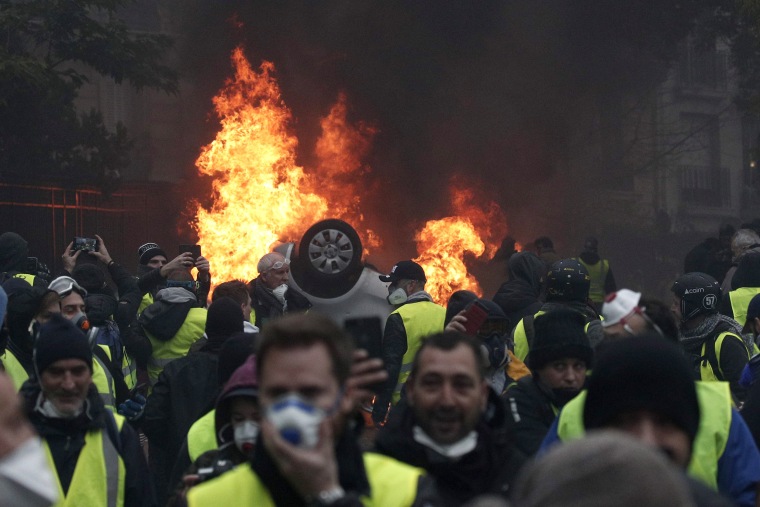
France's violent 'yellow vest' protests are about much more than a fuel tax. But is President Macron listening?
This weekend, Paris braces itself for the fourth round of gilets jaunes(yellow vest) protests, the French anti-tax social movement that has been growing since mid-November. After last weekend, which saw the worst unrest in Paris in decades, French authorities are still struggling to contain the movement or address its demands. In panic mode, the French government appears to be accumulating mistakes, from tone-deaf declarations to police violence, seemingly unaware of the public indignation these missteps are fueling. The first signs of social unrest emerged in late October, shortly after the announcement of a new tax on diesel fuel. The tax is part of President Emmanuel Macron’s big plan to tackle climate change. For French people living in rural and peripheral areas of the country, people who depend on their car to live and work, this tax was the last straw in a series of fiscal policies seen as unjust and favoring the upper classes. In response, fed-up citizens organized blockades on roads, roundabouts and highway tolls around the country. The protests are symbolic — participants have worn the neon safety vest all French drivers must have in their cars — and politically savvy — slowing down traffic had an immediate economic impact. The movement united 282,000people nationwide on November 17, the first day of the protests, and 166,000 people a week later.
But while the fuel tax was the initial pain point, these protests aren’t really about gas; they are about French financial woes more generally. “[The elites] worry about the end of the world while we worry about the end of the month,” Jean-Marc Mourey, a gilet jaune in eastern France told Le Monde. Addressing the protestors on November 27, Emmanuel Macron promised he would “take care of both” the end of the world and the month — but did not say he would rescind the tax. The French president, elected in 2017 on a neoliberal platform, had until then seemed impervious to criticism; the new labor laws in September 2017 and the reform of the rail system earlier this year both were met with protests, but Macron hadn't budged.
This is clearly no longer the case, as the darling of the Western press has found himself under attack by violent “hooligans” hurling projectiles, erecting barricades, burning down cars and breaking into shops. On the Arc de Triomphe, the arch on the Champs-Elysées,
The French government doesn't seem willing or able to defuse the current situation.
LONDON -- With a crucial parliamentary vote on Brexit looming, British Prime Minister Theresa May warned lawmakers Sunday that they could take Britain into "uncharted waters" and trigger a general election if they reject the divorce deal she struck with the European Union. May is fighting to save her unpopular Brexit plan and her job ahead of a showdown in Parliament on Tuesday, when lawmakers are widely expected to vote down the deal she negotiated with Brussels. Her Downing Street office insisted that the vote will go ahead despite speculation that the government may be forced to delay it. A defeat in the vote could see Britain crashing out of the EU on March 29, the date for Britain's exit, with no deal in place -- an outcome that could spell economic chaos.