


[h=1]Rare photos of the SR-71 Blackbird show its amazing history[/h]Powered by a pair of Pratt & Whitney J-58 single-spool turbojets (more on them later), the SR-71 generated 60,000 lbf of thrust at takeoff, making it one of the most powerful twin-engine military aircraft until the advent of the F-22 Raptor. These engines able to hurl the Blackbird across the skies at speed in excess of 2100 miles per hour, or 33 miles a minute.
Go for altitude. SR-71s regularly flew at altitudes of 85,000 feet, far above the reach of most aircraft. Yes, some fighters could zoom climb even higher... but that was when they were stripped down to the bare minimums. No guns, no missiles... not even paint. So the only way to shoot down the SR-71 was with missiles, right? Wrong. Many tried. Numerous reports detail the SR-71 being fired upon over Vietnam in the late 60's and early 70's, but no missile ever came close enough to be a threat. Why?
You see, the SR-71 flew at an an altitude where missiles that were designed to hunt for targets much deeper in the atmosphere just couldn't turn hard enough to catch the infamously swift and slippery Blackbird. The crew would see the Electronic CounterMeasures (ECM) lindicator light come on, and the pilot would just open the throttle a touch more. Score? HABU 1, Missile 0.

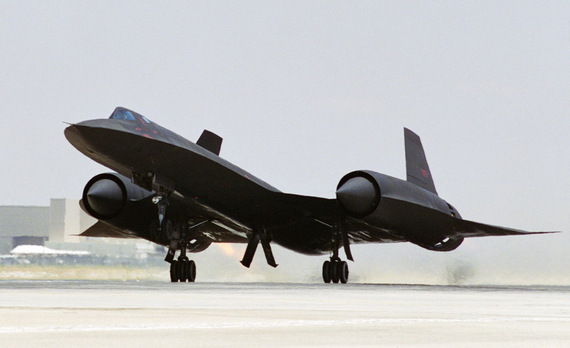


https://sploid.gizmodo.com/rare-photos-of-the-sr-71-blackbird-show-its-amazing-his-1670184930
The need for such a swift strategic reconnaissance aircraft became apparent in 1960, when the Blackbird's subsonic predecessor, the U-2, was rendered a sitting duck by Russian radar. The Skunk Works, Lockheed's secretive advanced development division, succeeded in getting a test version--the A-12--off the ground at Groom Lake (a.k.a. Area 51) in April, 1962--development as head-spinningly fast as the aircraft itself.
Even more astonishing was the tech, frequently summed up at the time as "black magic." Topping a long list of revolutionary components were monstrous Pratt & Whitney J58 jet engines and a design that drastically reduced radar signature, pioneering "stealth" technology. If Russian missiles ever did manage to lock on to a Blackbird, it could simply outrun them. Said a sign over the entrance to an SR-71 base, "Though I Fly Through the Valley of Death I Shall Fear No Evil--For I am at 80,000 Feet and Climbing."
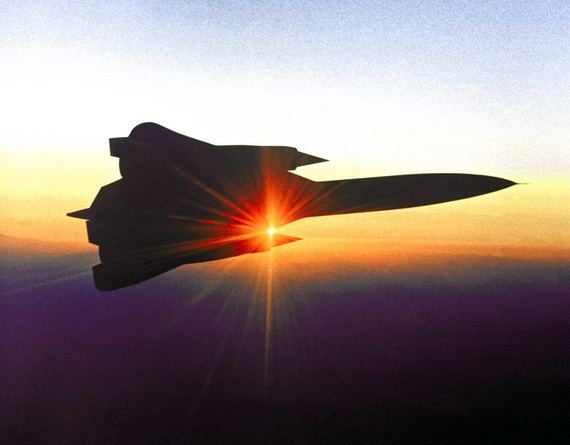
Go for altitude. SR-71s regularly flew at altitudes of 85,000 feet, far above the reach of most aircraft. Yes, some fighters could zoom climb even higher... but that was when they were stripped down to the bare minimums. No guns, no missiles... not even paint. So the only way to shoot down the SR-71 was with missiles, right? Wrong. Many tried. Numerous reports detail the SR-71 being fired upon over Vietnam in the late 60's and early 70's, but no missile ever came close enough to be a threat. Why?
You see, the SR-71 flew at an an altitude where missiles that were designed to hunt for targets much deeper in the atmosphere just couldn't turn hard enough to catch the infamously swift and slippery Blackbird. The crew would see the Electronic CounterMeasures (ECM) lindicator light come on, and the pilot would just open the throttle a touch more. Score? HABU 1, Missile 0.
https://sploid.gizmodo.com/rare-photos-of-the-sr-71-blackbird-show-its-amazing-his-1670184930
The need for such a swift strategic reconnaissance aircraft became apparent in 1960, when the Blackbird's subsonic predecessor, the U-2, was rendered a sitting duck by Russian radar. The Skunk Works, Lockheed's secretive advanced development division, succeeded in getting a test version--the A-12--off the ground at Groom Lake (a.k.a. Area 51) in April, 1962--development as head-spinningly fast as the aircraft itself.
Even more astonishing was the tech, frequently summed up at the time as "black magic." Topping a long list of revolutionary components were monstrous Pratt & Whitney J58 jet engines and a design that drastically reduced radar signature, pioneering "stealth" technology. If Russian missiles ever did manage to lock on to a Blackbird, it could simply outrun them. Said a sign over the entrance to an SR-71 base, "Though I Fly Through the Valley of Death I Shall Fear No Evil--For I am at 80,000 Feet and Climbing."


