

Made with Love

Hubble Telescope Observes Matter Falling Into Black Hole

Austin

Member
Joined
Sep 13, 2011
Messages
12
For the first time, scientists working at the Hubble Space Telescope were able to directly observe a quasar accretion disc. A quasar accretion disc is the glowing matter slowly spiraling into a supermassive black hole at the center of a galaxy. Although quasars are light days across, they are billions of light years from Earth, which means that most of what scientists know about them comes from extrapolations and not direct evidence.

The scientists were able to observe the quasars using a technique called gravitational lensing. This involves taking advantage of distant, but cloesr, galaxies that lie between Earth and the quasar.

By examining how the way light passes through different parts of the distant galaxy, features of the quasar can be determined in a way that’s not possible by directly aiming the telescope at it.Changes in the way the light moves comes from the way gravity bends the light as it travels from the quasar towards Earth.

The bending creates a lensing effect in the same way that light is bent through glass or plastic in a microscope or your eyeglasses.
Using this technique, researchers were able to directly determine the temperatures at different parts of the quasar, and determine measurements of its size.

That in turn enabled them to learn more about the properties of the matter in the quasar as it moves ever closer towards the event horizon of the black hole. These observations will go a long way towards refining what we know about quasars, and what conditions were like in the universe billions of years ago.

 
If you're into this kid of stuff there was a most excellant program on Nova this past week about the fabric of the universe and how space is actually not "empty" but full of particles and actually closely resembles a stretchy fabric.

It went on to explain about how planets etc exert a force onto this fabric and how this bending of space causes things to go into orbit. (big lightbulb went on over my head when I saw this....).

it also got into light speed and how the universe constantly adjusts to keep light travelling at 67.1 million mph. Even if an object producing light is travelling at 100,000 mph, light always travels at the same speed. I could never get why Einstein theorized how something could never surpass the speed of light and how time is affected by travelling at or near the speed of light. Since the universe effectively slows down to keep light at the same speed, time inside an object travelling at or near the speed of light would remain the same, yet the rest of the universe would slow down. Hence why they said if you travelled at the speed of light you'd age at one rate, and the rest of the universe would age at another......

I tell you, it was some heavy shit to put in the noodle before bed.........

https://www.pbs.org/wgbh/nova/physics/fabric-of-cosmos.html
 
If you're into this kid of stuff there was a most excellant program on Nova this past week about the fabric of the universe and how space is actually not "empty" but full of particles and actually closely resembles a stretchy fabric.

It went on to explain about how planets etc exert a force onto this fabric and how this bending of space causes things to go into orbit. (big lightbulb went on over my head when I saw this....).

it also got into light speed and how the universe constantly adjusts to keep light travelling at 67.1 million mph. Even if an object producing light is travelling at 100,000 mph, light always travels at the same speed. I could never get why Einstein theorized how something could never surpass the speed of light and how time is affected by travelling at or near the speed of light. Since the universe effectively slows down to keep light at the same speed, time inside an object travelling at or near the speed of light would remain the same, yet the rest of the universe would slow down. Hence why they said if you travelled at the speed of light you'd age at one rate, and the rest of the universe would age at another......

I tell you, it was some heavy shit to put in the noodle before bed.........

https://www.pbs.org/wgbh/nova/physics/fabric-of-cosmos.html

Like always (Ok-most of the times) thanks for your input Tboy.
 
lol @ most of the time....hey I'm like a broken clock that's right twice a day!!!

One of the cool things about Nova is they try to put things in a way that even non-physicists can understand. They say "space is like a stage upon which a play is being acted out. You don't notice the stage, but it's there". In addition, even though you don't realize it, a stage is made up of lights, floor, walls, electrical etc. Just like space, we don't notice it, we don't think about it, but it's there and has all sorts of stuff in it.

I heard about this before, but one of the clues that there actually might be other dimensions is the fact that on the molecular level, there are particles (which fill up a lot of space) that wink in and out of existence. Like they say "they are there, they go, they come back. Where are they going"???

Another good analogy: SInce there is so much empty space between protons, neutrons, electrons, atoms and particles. If you removed all the empty space between all that makes up the materials used to construct the empire state building, all that you'd be left of of actual solid matter, is about the size of a grain of rice......
 
lol @ most of the time....hey I'm like a broken clock that's right twice a day!!!

One of the cool things about Nova is they try to put things in a way that even non-physicists can understand. They say "space is like a stage upon which a play is being acted out. You don't notice the stage, but it's there". In addition, even though you don't realize it, a stage is made up of lights, floor, walls, electrical etc. Just like space, we don't notice it, we don't think about it, but it's there and has all sorts of stuff in it.

I heard about this before, but one of the clues that there actually might be other dimensions is the fact that on the molecular level, there are particles (which fill up a lot of space) that wink in and out of existence. Like they say "they are there, they go, they come back. Where are they going"???

Another good analogy: SInce there is so much empty space between protons, neutrons, electrons, atoms and particles. If you removed all the empty space between all that makes up the materials used to construct the empire state building, all that you'd be left of of actual solid matter, is about the size of a grain of rice......

I got all excited thinking Tboy had just posted and then noticed the posted date.

Thank you Sarah!:grrrrrr:

Cool pictures though.
 
Madman said:
I got all excited thinking Tboy had just posted and then noticed the posted date.

Thank you Sarah!:grrrrrr:

Cool pictures though.

I chose this thread because I saw tboy was the last one to post.

I guess he left before I got here - but I wish he'd come back now that I've read some of his posts. Praise-Bowing
 
escapefromstress said:
I chose this thread because I saw tboy was the last one to post.

I guess he left before I got here - but I wish he'd come back now that I've read some of his posts. Praise-Bowing

I think we need to give our former friend three cheers which if he's watching will make him feel warm and fuzzy

CUNT CUNT CUNT
 
...Although quasars are light days across...


A box of Light Days can't be more than six, maybe eight inches across. How can we see those Quasars from light years away? They probably have their high beams on. That must be it.

Thanks for the astronomy story, Austin.

I think there is a finite density to a black hole, and that's why there is a big bang every 60 billion years or so, when all of the black holes start to attract each other, and they explode, when their density reaches the maximum, like the fat guy in Monty Python's The Meaning of Life, when he ate the after dinner mint.
 
bobistheowl said:
A box of Light Days can't be more than six, maybe eight inches across. How can we see those Quasars from light years away? They probably have their high beams on. That must be it.

Thanks for the astronomy story, Austin.

I think there is a finite density to a black hole, and that's why there is a big bang every 60 billion years or so, when all of the black holes start to attract each other, and they explode, when their density reaches the maximum, like the fat guy in Monty Python's The Meaning of Life, when he ate the after dinner mint.

Your stupidity is showing again, BITI.
 
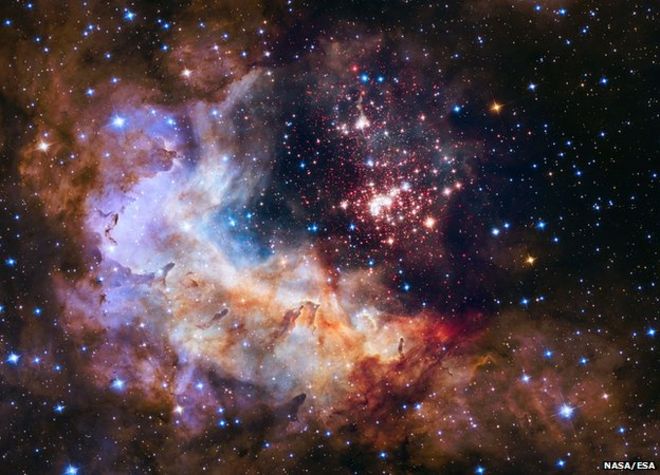
The famous observatory is about to celebrate its 25th birthday.

Scientists say they have every hope that the Hubble Space Telescope will keep working for at least another five years, perhaps more.

Key figures on the mission told a major conference in California that the instruments it uses to detect objects on the sky are all in perfect health. A big portion of Hubble's time is now dedicated to finding the very first stars to shine in the Universe.

After its ignominious start in 1990 when it launched with a mirror that could not focus properly, the space telescope has gone on to notch a list of remarkable discoveries.

From confirming there were gigantic black holes in space to refining the age of the Universe - Hubble has had a part in many of the big breakthroughs in modern astronomy.

The fact that it still does peerless science is down to all those visits from astronauts who repaired and upgraded its systems.

After the retirement of the space shuttle, those sorts of interventions are no longer possible but Hubble is said to be in superb shape.

"The last servicing mission was in 2009 and the astronauts did an incredible job," said Dr Jennifer Wiseman, Nasa's Hubble project scientist.

The Butterfly Nebula: One of the first pictures to be released following the final astronaut servicing mission

_81051374_81051373.jpg


https://www.bbc.com/news/science-environment-31499061
 
Back
Top Bottom