B
Made with Love

Navigation
Install the app
How to install the app on iOS
Follow along with the video below to see how to install our site as a web app on your home screen.
Note: This feature may not be available in some browsers.
More options


You are using an out of date browser. It may not display this or other websites correctly.
You should upgrade or use an alternative browser.
You should upgrade or use an alternative browser.
Who is at wrong here?.
Cardinal Fang
Reviewer
- Joined
- May 9, 2012
- Messages
- 5,717
They both acted like asshats.
P
Prick
Guest
- Thread starter
- #4
Cardinal Fang said:They both acted like asshats.
Both are pricks.
H
HOF
Guest
- Thread starter
- #5
Please correct if I'm wrong, but are cyclists supposed to stay single file? If so, then the cyclist is in the wrong and I would politely said that to him because he can't accelerate as quickly as the car and would be impeding traffic. If that fails, run him down, get out kick the shit out of him and wait for police. Go to jail and be hero.:LMAO:
- Joined
- Jan 10, 2012
- Messages
- 1,682

A
Art Mann
Guest
- Thread starter
- #8
Anto said:The cyclist without question.
Really?
He may be an asshole, but is that reason to jump out of your car and start pummelling someone with your fists?

Maurice Boscorelli
Senior Member
- Joined
- May 30, 2010
- Messages
- 19,322
Life's to short to worry over these things. Both need a time out to think about the bigger picture.
I blame the cyclist who escalated the situation. Yes the passenger jumped out but we can't see what happened prior to him being out. Did the cyclist attempt to open the door, did the cyclist attempt to vandalize their expensive car. I'm not a proponent of violence but if it's in self defense I usually will not condemn it either. The passenger punched and pulled back, he did not attack once he noticed the cyclist in retreat.
A
Art Mann
Guest
- Thread starter
- #11
For the sake of clarity, Baz, you should note that video was shot in Britain. That's the driver, not the passenger, who temporarily abandoned his car to use his fists.
Back to the original question: Who is at wrong here?
Not sure who, really, in the context of the actual dustup.
But in terms of replies, pretty sure I know who is right:
Back to the original question: Who is at wrong here?
Not sure who, really, in the context of the actual dustup.
But in terms of replies, pretty sure I know who is right:
Maurice Boscorelli said:Life's to short to worry over these things. Both need a time out to think about the bigger picture.
S
Senor Gomes
Guest
- Thread starter
- #12
Maurice Boscorelli said:Life's to short to worry over these things. Both need a time out to think about the bigger picture.
Hold on to all your hats.
A wise man spoke.
Art Mann said:For the sake of clarity, Baz, you should note that video was shot in Britain. That's the driver, not the passenger, who temporarily abandoned his car to use his fists.
Back to the original question: Who is at wrong here?
Not sure who, really, in the context of the actual dustup.
But in terms of replies, pretty sure I know who is right:
Yes, thank you for pointing that out but that makes even more sense that the driver would jump out to defend his property. I'm not sure what you drive Art but I too drive a luxury vehicle and the thought of someone kicking, punching or rubbing their bike against it is enough to have me jumping out of my car. I admittedly would never throw the first punch but if provoked and fear an act of violence I would not hesitate to defend myself, my loved ones or my property.
Blank_Dave
Reviewer
- Joined
- Jan 6, 2010
- Messages
- 1,780
Well, before we go casting blame on who is right and who is wrong here, we should look at all the facts. And let's face it, we're Canadians, and not Brits.
The thing I'm pointing at is the "box" the cyclists are stopping in. The car is stopped at a line, in front of that line is a "box" marked with a stylized bicycle emblem. What are their rules regarding bikes and this box? Are cyclists allowed to go multiple riders wide in there? It's questions along these lines that I wonder about.
I'll also point out the conflict didn't start until the motorist attempted to pull into/around said box, and the cyclist decided to speak his mind.
The thing I'm pointing at is the "box" the cyclists are stopping in. The car is stopped at a line, in front of that line is a "box" marked with a stylized bicycle emblem. What are their rules regarding bikes and this box? Are cyclists allowed to go multiple riders wide in there? It's questions along these lines that I wonder about.
I'll also point out the conflict didn't start until the motorist attempted to pull into/around said box, and the cyclist decided to speak his mind.
Blank_Dave
Reviewer
- Joined
- Jan 6, 2010
- Messages
- 1,780
Bum bum bummmmm...A little research yields a result....
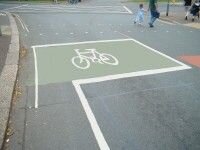
So....I would say the motorist would be initially in the wrong, as he had no business being in the box.
But I"ll look up more on it.
Whoops forgot linkies. Wikipedia
Advanced Cycle Stop Lines. An advanced stop line reservoir at a signalled junction is a marked and signed area (usually having a coloured surface with a cycle symbol in it), like a box in front of the stop line of traffic signals, which give cyclists a safe, visible area to wait, where they are segregated from other traffic. It allows cyclists to move ahead before other vehicles, making it safer for cyclists to turn left or right. A typical example is shown below.
So....I would say the motorist would be initially in the wrong, as he had no business being in the box.
But I"ll look up more on it.
Whoops forgot linkies. Wikipedia
Blank_Dave
Reviewer
- Joined
- Jan 6, 2010
- Messages
- 1,780
[url="https://content.met.police.uk/Article/Advanced-Stop-Lines/1400018009433/1400018009433]Advanced Stop Lines[/url]
Sorry guys, I don't see an exception for those of you with fancy luxury cars.
[h=1]Advanced Stop Lines[/h]Some signal-controlled junctions have Advanced Stop Lines (ASLs). ASLs help motorists and cyclists by providing an area for cyclists to wait in front of traffic when the lights are red. Cyclists in this area are more easily visible to motorists, and have space to move off when the lights turn green.
Motorists, including motorcyclists, MUST stop at the first white line reached if the lights are amber or red and should avoid blocking the way or encroaching on the marked area at other times, e.g. if the junction ahead is blocked.
[h=2]Motorists[/h] Do not enter the ASL box when the light is red – this space is reserved for the safety of cyclists.
Crossing the first or second ASL line when the light is red makes you liable for a £100 fixed penalty, three points on your licence, and endangers vulnerable road users.
If the traffic light changes from green to amber and you cannot safely stop before the first stop line, you may cross the line but must stop before the second stop line (Highway Code rule 178).
[h=2]Cyclists[/h] Do not cross the second stop line while the traffic signal is red. Contravening a traffic signal is against the law, and could result in a £50 fine.
[h=2]Myth Busting[/h] Myth: There’s a car in the ASL box - the driver must have committed an offence.
Not true. The offence is committed when the vehicle enters the ASL box when the light is red. If the vehicle enters the box and the light changes to red, no offence is committed
Rule 178 of the Highway Code states:
If your vehicle has proceeded over the first white line at the time that the signal goes red, you MUST stop at the second white line, even if your vehicle is in the marked area.
We don’t want motorists to wrongly believe that they shouldn’t stop in the ASL box under any circumstances – this might cause someone to panic, drive through a junction and cause an accident.
Myth: Motorbikes are allowed in the ASL.
Not true. The law applies to motorbikes and scooters, too.
Myth: Entering an ASL is a specific offence.
Not true. Entering an ASL when the light is red is an offence under section 36(1) of the Road Traffic Act 1988, regulation 10 of the Traffic Signs Regulations and General Directions 2002 and Schedule 2 to the Road Traffic Offenders Act 1988. The offence is jumping a red light and could result in a £100 fixed penalty and three points on your licence.
Myth: Police don’t enforce ASLs.
Not true. The Cycle Task Force and our colleagues across the MPS regularly report and warn drivers for contravening this law and are supporting Transport for London’s ASL campaign. Any Police Constable (not a Police Community Support Officer) who witnesses an ASL offence taking place can enforce and must provide evidence that they witnessed:
If the officer sees the vehicle in the zone without witnessing all three of the above, then there is no prospect of prosecution against a burden of proof of ‘beyond reasonable doubt’. In any case, the driver could simply have been obeying rule 178 of the Highway Code (see above).
- The front of the vehicle cross the stop line
- The moment the traffic lights changed
- The traffic lights were all working
Sorry guys, I don't see an exception for those of you with fancy luxury cars.
A
Art Mann
Guest
- Thread starter
- #18
Blank_Dave said:Sorry guys, I don't see an exception for those of you with fancy luxury cars.
Check again, Dave. There's gotta be one for Baz and Chunky.

papasmerf
Senior Member
- Joined
- Aug 9, 2010
- Messages
- 33,614
Transient said:No one touches the car in the video.
but still Chunky drives a fancy yellow cab
Similar threads
- Replies
- 0
- Views
- 412

- Replies
- 0
- Views
- 131
- Replies
- 1
- Views
- 754

- Replies
- 0
- Views
- 698
Latest posts
-
🍎🍎MONDAY@GOE🍎🍎ZOE + MARIA + KATARINA + ALICE + MARINA🍎🍎INCALLS/OUTCALLS
- Latest: Garden of Eden
