

Made with Love

Winter and all season driving tips.

  • Thread starter Thread starter TINY
  • Start date Start date
shadowsun said:
That's what happened out here in certain areas. The hills are super steep, the roads narrow. There was this news story of half a dozen cars just sliding down one hill and crashing into other cars that had already slid down. (no one has the right kind of tires, but not sure those would help to be honest.)

In both Washington and Oregon tire chains or aggressive winter tires and a 4x4 are required by law to drive in certain areas when there is snow.
 
More snow coming tonight, sheesh it's never going to stop!

Al Gore deserves to be smacked!
 
Winter Driving Tips: Do’s & Don’ts of Winter Driving

Winter Driving Tips: Do’s & Don’ts of Winter Driving

I just bought all season tires for my SUV with recommendations from my mechanic. What do I do now?

Would like to hear from members with tire expertise.

Thanks in advance.
 
Wanker said:
I just bought all season tires for my SUV with recommendations from my mechanic. What do I do now?

Would like to hear from members with tire expertise.

Thanks in advance.
Do not over inflate them in the winter.............Better rubber to road contact

In icy conditions and wet conditions do not use cruise control. The cruise sees the tires slipping as a loss of speed and accelerates.

At lower speeds 4WD help you gain traction. At highway speeds it helps you loose control.
 
papasmerf said:
Do not over inflate them in the winter.............Better rubber to road contact

In icy conditions and wet conditions do not use cruise control. The cruise sees the tires slipping as a loss of speed and accelerates.

At lower speeds 4WD help you gain traction. At highway speeds it helps you loose control.

Thanks Pa, didn't know that.
 
Find a big empty parking lot or some other place with no traffic to test the tires on snow and ice, rather than wait to test them on the road at high speeds in heavy traffic. That way you can see for yourself how much room you need to stop, see how they handle when you have to brake quickly, etc.
 
Wanker said:
I just bought all season tires for my SUV with recommendations from my mechanic. What do I do now?

Would like to hear from members with tire expertise.

Thanks in advance.

First, put them on the SUV. :-Cool/"

Seriously, I own a very large SUV (Infiniti QX56), had two of them over a ten year period, and find the winter tires are a great addition to traction when pulling through snow. The weight of the SUV is enough to give decent traction even with all seasons except on icy roads and lots of powder (when the treads fill up) but I've plowed through three foot snowfalls in the QX56 with winters on. There's a sense of security that is worth every penny, in both two wheel and four wheel drive mode. Just be aware the tires will increase road noise on dry pavement, and tend to wear out faster on pavement than summer or all-season tires.
 
Matters not what kind of tires your car has. If you drive like a maniac during snowfall then suck it in for being a loser.
 
A-Legend said:
Matters not what kind of tires your car has. If you drive like a maniac during snowfall then suck it in for being a loser.


Where have I read that before?? :LMAO:
 
papasmerf said:
Where have I read that before?? :LMAO:

tiCFqF9.png
 
I actually keep an aggressive all season on my vehicle and plow with it.

The key to traction is decent rubber on the road. On ice the physics of ice is hard to overcome.............You slow down and hope for the best.
 
You have to look at ice and snow differently.

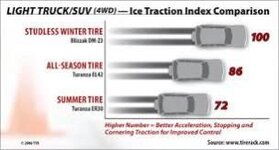
With snow, the trick is to not pack the treads so they become slicks. That is why winter tires have wider and deeper treads: they are designed to "throw" the snow out of the tread. Summers and all-seasons are narrower and less deep, allowing snow to pack in and become a slick, with no traction possible on snow.

For ice, it's about the contact patch and how much friction the tire can get. Winters are softer rubber and have a wider contact patch than summers and all-seasons, which is why they wear a lot faster.

Of course, tire inflation is the key, not matter what tire you use. In the end, experience will dictate what your winter conditions and your driving habits warrant. I drive 1,000km most weekends and in winter I put dedicated winter tires on my SUV and cars.
 

Attachments

  • untitled.jpg
    untitled.jpg
    9.4 KB · Views: 16
oldguyzer said:
You have to look at ice and snow differently.

With snow, the trick is to not pack the treads so they become slicks. That is why winter tires have wider and deeper treads: they are designed to "throw" the snow out of the tread. Summers and all-seasons are narrower and less deep, allowing snow to pack in and become a slick, with no traction possible on snow.

For ice, it's about the contact patch and how much friction the tire can get. Winters are softer rubber and have a wider contact patch than summers and all-seasons, which is why they wear a lot faster.

Of course, tire inflation is the key, not matter what tire you use. In the end, experience will dictate what your winter conditions and your driving habits warrant. I drive 1,000km most weekends and in winter I put dedicated winter tires on my SUV and cars.

I miss studded tires.

Where my Baby is they want you to have them
 
papasmerf said:
I actually keep an aggressive all season on my vehicle and plow with it.

The key to traction is decent rubber on the road. On ice the physics of ice is hard to overcome.............You slow down and hope for the best.

It's always the icy days where I see more SUVs in the median. Knuckleheads think AWD allows them to drive at normal speeds. Once you break traction on ice, Newton's Laws take over.
 
Back
Top Bottom