


Made with Love

Neutrino experiment repeat at Cern finds same result

  • Thread starter Thread starter Wanker
  • Start date Start date
W

Wanker

Guest
The team which found that neutrinos may travel faster than light has carried out an improved version of their experiment - and confirmed the result.
If confirmed by other experiments, the find could undermine one of the basic principles of modern physics.

Critics of the first report in September had said that the long bunches of neutrinos (tiny particles) used could introduce an error into the test.
The new work used much shorter bunches.

It has been posted to the Arxiv repositoryand submitted to the Journal of High Energy Physics, but has not yet been reviewed by the scientific community.
The experiments have been carried out by the Opera collaboration - short for Oscillation Project with Emulsion (T)racking Apparatus.
It hinges on sending bunches of neutrinos created at the Cern facility (actually produced as decays within a long bunch of protons produced at Cern) through 730km (454 miles) of rock to a giant detector at the INFN-Gran Sasso laboratory in Italy.

The initial series of experiments, comprising 15,000 separate measurements spread out over three years, found that the neutrinos arrived 60 billionths of a second faster than light would have, travelling unimpeded over the same distance.
The idea that nothing can exceed the speed of light in a vacuum forms a corne

rstone in physics - first laid out by James Clerk Maxwell and later incorporated into Albert Einstein's theory of special relativity.

Timing is everythingInitial analysis of the work by the wider scientific community argued that the relatively long-lasting bunches of neutrinos could introduce a significant error into the measurement.

Those bunches lasted 10 millionths of a second - 160 times longer than the discrepancy the team initially reported in the neutrinos' travel time.
To address that, scientists at Cern adjusted the way in which the proton beams were produced, resulting in bunches just three billionths of a second long.
When the Opera team ran the improved experiment 20 times, they found almost exactly the same result.


"This is reinforcing the previous finding and ruling out some possible systematic errors which could have in principle been affecting it," said Antonio Ereditato of the Opera collaboration.

"We didn't think they were, and now we have the proof," he told BBC News. "This is reassuring that it's not the end of the story."
The first announcement of evidently faster-than-light neutrinos caused a stir worldwide; the Opera collaboration is very aware of its implications if eventually proved correct.
The error in the length of the bunches, however, is just the largest among several potential sources of uncertainty in the measurement, which must all now be addressed in turn; these mostly centre on the precise departure and arrival times of the bunches.

"So far no arguments have been put forward that rule out our effect," Dr Ereditato said.
"This additional test we made is confirming our original finding, but still we have to be very prudent, still we have to look forward to independent confirmation. But this is a positive result."

That confirmation may be much longer in coming, as only a few facilities worldwide have the detectors needed to catch the notoriously flighty neutrinos - which interact with matter so rarely as to have earned the nickname "ghost particles".

Next year, teams working on two other experiments at Gran Sasso experiments - Borexino and Icarus - will begin independent cross-checks of Opera's results.
The US Minos experiment and Japan's T2K experiment will also test the observations. It is likely to be several months before they report back.

https://www.bbc.co.uk/news/science-environment-15791236
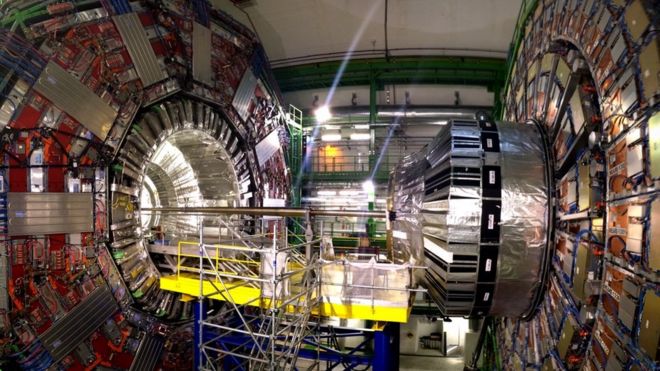
 
_81287290_img_0110.jpg


Run Two of the Large Hadron Collider is set to ramp up next week but beams will not go full circle before Wednesday, according to scientists at Cern.

The LHC has been shut down since early 2013, in order for the gigantic machine to be serviced and upgraded. It is now ready to run at its "design energy" - which means it will smash protons together with nearly double the energies reached during Run One. But restarting is a gradual process and every step has to be taken carefully.

Scientists working on the LHC's experiments, spaced around its famous 27km circle, now say that because of all the checking that must be done, they are not expecting proton beams until at least 25 March. This is on schedule, since the notional "restart" - defined by some as beams proceeding, inside their two pipes, all the way around the LHC in both directions - was previously promised for sometime "in the week commencing 23 March".

Even once the beams are doing complete laps, the teams do not expect to be creating actual collisions for about another two months. This is not a process that anybody wants to rush.

"It is practically a new machine," said Rolf Heuer, Cern director general, at a press conference last week. "You have to remember that during the shut down we opened the machine essentially every 20m." During that maintenance, he added, every single one of the connections between the LHC's 10,000 magnets - which steer the proton beams in a precise circle - was inspected and reinforced, "in order to be rock stable, even if there is a movement of the magnets when they go from cold to warm, or the other way around".

These superconducting electromagnets are chilled to -273C (colder than outer space) in order to do their job. Inside the beams themselves, on the other hand, things have the potential to get very hot. "You must be very careful switching on such a high power laser, so to speak, because it has a power which could melt 500 kg of copper - each beam," Dr Heuer said. "So both beams together - one tonne of copper! We don't want to do that."

So the scientists working on the seven major physics experiments (the four biggest ones being Atlas, CMS, LHCb and Alice) must be patient. They all have different sorts of detectors, many of which have also been serviced and upgraded since 2013, ready and waiting to catch all the subatomic particles that spray out of the high-energy proton collisions. Then comes the immense task of analysing the data to calculate a debris particle's energy, mass and direction - and to see if anything surprising can be revealed.

But before any of this can happen, there must be beams. "The moment they turn back on, we'll be ready and waiting for them," said Dave Charlton, spokesperson for Atlas.

https://m.bbc.com/news/science-environment-31849632
 
You guys got me after the first couple of paragraphs.

Cole notes please.
 
X-rays probe LHC for cause of short circuit

Early last Saturday morning, while full-scale tests of all systems were ongoing in preparation for beam injection, an earth fault developed in the main dipole circuit of sector 3-4 of the Large Hadron Collider (LHC). All the protection systems worked properly and there was no harm done. The fault developed at relatively low current and was initially intermittent in nature.

Measurements by system experts have located the fault to within 10 cm by injecting current locally and using the standard cold mass instrumentation, which includes voltage and current taps. Each dipole of the LHC has a diode stack situated in a box under the magnet. The diode provides a path for current in the event of a quench. The fault is located in the vertical tube that leads from the magnet enclosure to the diode box. The most probable scenario is that a small piece of metal has found its way into this tube and is making contact between the tube (earth) and one of the cables that leads to the diode.

To further understand the cause of the short circuit, engineers X-rayed the affected dipole last night. Though some fragments of metal can be seen on the X-ray, the results are, as yet, inconclusive.

The operations team is now exploring three main options to fix the short: inject a controlled pulse of current to try to melt the offending object; try to dislodge the object by altering the flow of helium in that region; partially warm up the sector and open the magnet interconnect concerned. Though the third option would allow direct access to the diode box, the warm-up, intervention, and subsequent cool-down would take around 6 weeks.

A careful evaluation of each option is ongoing.

https://home.web.cern.ch/about/updates/2015/03/pictures-x-rays-probe-lhc-cause-short-circuit
 
Large Hadron Collider restarts after two-year rebuild

The Large Hadron Collider has restarted, with protons circling the machine's 27km tunnel for the first time since 2013. Particle beams have now travelled in both directions, inside parallel pipes, at a whisker below the speed of light.

Actual collisions will not begin for at least another month, but they will take place with nearly double the energy the LHC reached during its first run. Scientists hope to glimpse a "new physics" beyond the Standard Model.


https://www.bbc.com/news/science-environment-32160755
 
LHC restart sees first collisions

The Large Hadron Collider has smashed protons together for the first time since early 2013.

The low-energy collisions, part of preparations for the next round of experiments, began on Tuesday morning. Proton beams circled the LHC and collided at an energy of 450 gigaelectronvolts (GeV) per beam.

The aim for this second run of the LHC, following its planned two-year shutdown for repairs and improvements, is to stage collisions at 7,000 GeV per beam.

https://www.bbc.com/news/science-environment-32590036
 
LHC smashes energy record with test collisions

A new record has been set by the Large Hadron Collider: its latest trials have smashed particles with vastly more energy than ever before.

On Wednesday night, two opposing beams of protons were steered into each other at the four collision points spaced around the LHC's tunnel.

The energy of the collisions was 13 trillion electronvolts - dwarfing the eight trillion reached during the LHC's first run, which ended in early 2013.

"Physics collisions" commence in June.

At that point, the beams will contain many more "bunches" of protons: up to 2,800 instead of the one or two currently circulating. And the various experiments will be in full swing, with every possible detector working to try to sniff out all the exotic, unprecedented particles of debris that fly out of proton collisions at these new energies.

For now, however, the collisions are part of the gradual testing process designed to ensure nothing is missed and nothing goes awry when the LHC goes into that full "collision factory" mode.

"We begin by bringing the beams into collision at 13 TeV (teraelectronvolts), and adjusting their orbits to collide them head-on," said Ronaldus Suykerbuyk from the operations team at Cern - the organisation based near Geneva in Switzerland that runs the LHC.

https://www.bbc.com/news/science-environment-32809636
 
The latest results from the LHC experiments are presented in Vienna

Source: CERN
Content: Press Release
Date Issued: 27 July 2015
*******************************************

The latest results from the LHC experiments are presented in Vienna

Geneva/Vienna, 27 July 2015. The world particle-physics community has convened in Vienna for the 2015 European Physical Society Conference on High Energy Physics (EPS-HEP2015), where the latest results in the field are being presented and discussed. These include the first results from Run 2 of the Large Hadron Collider (LHC) at CERN, which are being presented for the very first time, less than two months after the experiments started to take data at the unprecedented energy of 13 TeV, following a two-year long shutdown.

"It is much too early to expect any discovery, we will have to be patient," said CERN Director General Rolf Heuer. "Nevertheless, the LHC experiments have already recorded 100 times more data for the summer conferences this year than they had around the same time after the LHC started up at 7 TeV in 2010. We can sense a fantastic pioneering spirit as the physicists are looking at completely new data at an unexplored energy."

As for any machine exploring a new energy frontier, operators at the LHC face many challenges on a daily basis. Since the start of Run 2, they have been gradually increasing the intensity of the LHC's two beams, which travel in opposite directions around the 27-kilometre ring at almost the speed of light. The LHC has run at the record high energy with each beam containing up to 476 bunches of 100 billion protons, delivering collisions every 50 nanoseconds. In the coming days, the intensity should increase further with a new rhythm of 25 nanoseconds. After a planned technical stop in early September, the teams will also be able to increase the number of bunches with the goal of reaching more than 2000 bunches per beam by the end of 2015.

"During the hardware-commissioning phase, we have learnt to manage carefully the huge energy stored in the magnets. Now with beam commissioning we have to learn progressively how to store and handle the beam energy," said CERN Director of Accelerators and Technology Frédérick Bordry. "Our goal for 2015 is to reach the nominal performance of the LHC at 13 TeV so as to exploit its potential from 2016 to 2018."

The LHC has already delivered over 10 thousand billion collisions to the large experiments since the start of Run 2. This has allowed the LHC collaborations to measure a full suite of detector performance parameters that demonstrate the readiness of the experiments for discovery physics and precision measurements. The next step was to confirm the Standard Model at the new energy of 13 TeV. After only a few weeks of data taking, the experiments have now “rediscovered” all of the known fundamental particles, apart from the so-called Higgs boson, for which more data are still required. The collaborations are thus ready to test the Standard Model at 13 TeV and the hope is to find evidence of new physics beyond this well-established theory.

At the EPS-HEP2015 conference, the ATLAS and CMS collaborations presented the first measurements at 13 TeV on the production of charged strongly-interacting particles (hadrons). CMS has already submitted this result for publication - the first for the new energy region. Such measurements are important in understanding the basic production mechanism for hadrons.

The LHC experiments have also made the first measurements of cross-sections at 13 TeV. Cross-sections are quantities related to the probability for particles to interact, and their measurement is essential for identifying any new phenomena. For example, ATLAS has measured the cross-section for the production of pairs of top quarks and antiquarks, which is some three times higher at 13 TeV than at the energy of Run 1.

In addition, the conference is providing the opportunity for all of the LHC experiments to present many new or final results from the first run at the LHC. These include searches for dark matter, supersymmetric and other exotic particles, as well as new precision measurements of Standard Model processes.

In this respect, one highlight in Vienna is the presentation for the first time at an international conference of the recent discovery by the LHCb experiment of a new class of particles known as pentaquarks (see press release). LHCb also published today in Nature Physics a result confirming that a certain decay involving the weak force happens with beauty quarks having a "left-handed" spin. This result is consistent with the Standard Model, in contrast with previous measurements that allowed for a right-handed contribution.

In other highlights from Run 1, the ALICE and LHCb experiments have new results on long-range correlations in proton–lead collisions. The latest measurements show that the so-called "ridges" seen in the most violent collisions span across even larger longitudinal distances. In Run 2 data, ATLAS reported that the near-side ridge is seen in 13 TeV proton–proton collisions, with characteristics very similar to those observed by CMS in Run 1.

https://www.interactions.org/cms/?pid=1034903
 
They have also announced the discovery of several pentaquarks, which are entirely new (although theoretically predicted, never seen before). No teraquarks, although they will exist since pentaquarks are now confirmed.

Cool physics.
 
oldguyzer said:
They have also announced the discovery of several pentaquarks, which are entirely new (although theoretically predicted, never seen before). No teraquarks, although they will exist since pentaquarks are now confirmed.

Cool physics.

I'm surprised they didn't mention the pentaquarks in this article.

I follow CERN on Twitter, and I was a like a kid at Christmas when they announced the discovery last week.

It blows my mind every time they make new discoveries.

Same with the new photos of Pluto, I don't know why, but I got so excited!

:yahoo:
 
escapefromstress said:
I'm surprised they didn't mention the pentaquarks in this article.

I follow CERN on Twitter, and I was a like a kid at Christmas when they announced the discovery last week.

It blows my mind every time they make new discoveries.

Same with the new photos of Pluto, I don't know why, but I got so excited!

:yahoo:


Pluto was fantastic. Will repeat. :sorry2:
 
CERN’S SUMMER OF ROCK

When a rock star visits CERN, they don’t just bring their entourage with them. Along for the ride are legions of fans across the world – many of whom may not be the typical CERN audience. In July alone, four big acts paid CERN a visit, sharing their experience with the world: Scorpions, The Script, Kings of Leon and Patti Smith.

It all started with the Scorpions, the classic rock band whose “Wind of Change” became an anthem in the early 1990s. On 19 July, the band braved the 35-degree heat to tour the CERN site on foot – visiting the Synchrocyclotron and the new Microcosm exhibition. The rockers were very enthusiastic about the research carried out at CERN, and talked about returning in the autumn during their next tour stop.

Two days later, The Script rolled in. This Irish pop-rock band has been hitting the top of the charts since the early 2000s, with albums such as “Science & Faith” and “#3”. During their visit to the CCC and the ATLAS control centre, the band tweeted photos and messages to their 2.2 million followers. "There’s a deep connection between music and physics,” said lead singer Danny O'Donoghue. “ATLAS and the LHC really bring physics to life, and also share the knowledge with the world, which is very important."

That evening, The Script donned their CERN helmets on stage at Paléo and asked the audience to make a “C” sign for CERN. The resulting photo appeared all across their social media – an epic tribute to their visit.

CKeKcVjWcAE8iwF.jpg-large_image.jpeg


https://cds.cern.ch/journal/CERNBulletin/2015/32/News Articles/2038746?ln=en
 
CERN scientists create portable linear accelerator for imaging and cancer treatment

Housed in a tunnel 17 miles in circumference and as deep as 574 feet underground, the Large Hadron Collider (LHC) is significantly bigger than any hospital, but facilities will soon be able to harness its power — in a much smaller package.

Scientists at the European Organization for Nuclear Research (CERN), which built the LHC in collaborations with thousands of scientists and engineers around the world, have used the same technology to create what they’ve called a miniature linear accelerator, or mini-Linac, designed to be used in hospitals for cancer treatment and to produce radioisotopes for imaging.

It will be the first portable accelerator, the team of scientists at CERN, which is based in Meyrin, Switzerland, told HCB News via email.

The mini-Linac is made up of four modules that are each roughly 20 inches long, for a total package of a little more than 6.5 feet. Only one module has been constructed, though the scientists say that it is enough to validate the concept.

To develop the mini-Linac, the scientists had to double the operating frequency used for the radiofrequency quadrupole (RFQ), a linear accelerator component used in the acceleration of low-velocity ion beams. With the higher frequency, the accelerator can be more compact.

The device, the scientists said, is designed to produce low-intensity beams of charged particles, which can be used in a form of radiation therapy called hadrontherapy, which better targets tumors with less damage to the surrounding, healthy tissue. The device can also be used for the production of radioisotopes used for PET exams and could produce alpha emitters for brachytherapy, a common treatment for prostate cancer.

Being able to produce isotopes on site means that radioactive materials will no longer need to be transported and that a wider range of isotopes can be produced.

The high frequency RFQ for hadron therapy will be completed at the beginning of 2016, the scientists said. They have signed an agreement with an outside company to connect the RFQ to a linear accelerator and perform the first tests with the beam by the end of 2016.

https://www.dotmed.com/news/story/26702
 
Oh goody. :don'twantto-see:/

China Supercollider Could Win Race to Possess 'God Particle'

China will build a supercollider starting in 2020 that will eventually become the world's largest – twice as big as Switzerland's giant machine – to learn more about the Higgs boson, or "God Particle."

The Higgs boson, called by some as the "God particle" and which scientists believe could be the fundamental building block of the universe, was discovered at the physics lab at CERN's accelerator complex in Switzerland, according to The Guardian.

China's planned mega supercollider will smash subatomic particles into each other at high speeds. It will be double the size of the Large Hadron Collider at CERN, which was built in 2008 and is currently the world's largest supercollider, says its website.

https://www.newsmax.com/TheWire/china-supercollider-god-particle/2015/10/30/id/699752/
 
Has the LHC discovered a new particle?

_81406174_cern_624.gif


After its much heralded re-start last year, has the world's biggest machine, the Large Hadron Collider, found a new particle?

You could be forgiven for thinking that things had gone a little quiet at Cern in Switzerland after the LHC was switched on to great fanfare in April 2015.

But physicists have been hard at work crunching data collected by the world's most powerful particle accelerator, which is now operating at unprecedented levels of energy and intensity.

Their efforts may not have been in vain, because there has been growing excitement in the hallways and offices at Cern in Geneva over a so-called "bump" in the data from the LHC's particle collisions.

The LHC smashes two beams of proton particles together about 100m beneath the French-Swiss border. Scientists then scour the debris of these smash-ups for hints of previously undiscovered particles.

Last year, out of trillions of such collisions, scientists detected more photon (light) particles being produced than expected - the aforementioned "bump". More precisely, they saw an excess of photon pairs with a combined mass of 750 Gigaelectronvolts (GeV).

This could be the tell-tale sign of a new, heavy particle that's about six times more massive than the famed Higgs boson - discovered at Cern in 2012.

The discovery of a new particle would be so exciting because the most widely accepted theory of particle physics, the Standard Model, can't explain everything we observe about the world around us.

It says nothing, for example, about dark matter - the mysterious stuff that makes up some 27% of the Universe. So scientists at Cern are searching for hints of new physical phenomena which could lead the way to a deeper understanding of the cosmos.

Signals have come and gone since the LHC first went online back in September 2008. Such statistical fluctuations are expected, and the bumps usually get ironed out with the addition of more data.

"More data is needed to be sure the signal doesn't go away - until then we have to be cautious," explained Prof Stefan Söldner-Rembold, head of particle physics at the University of Manchester. "The big reason that people are excited about this bump is that both experiments (Atlas and CMS) saw a hint in roughly the same place. But even this is not completely unlikely."

The gold standard for claiming a discovery in particle physics is a statistical threshold known as five sigma. This corresponds to a chance of one in 3.5 million that the observed signal is a fluke, and roughly the same likelihood as tossing a coin and getting 21 or 22 heads in a row.

A slew of scientific papers seeking to explain the anomaly have been uploaded to the Arxiv pre-print server in recent months. However, in the last few weeks, rumours have begun to circle on blogs about the signal fading as the latest data from the LHC are analysed.

Later this summer, the LHC experiments will present their newest results at a conference in Chicago with significantly more data. Indeed, officials at Cern said the LHC has already accumulated more data in 2016 than it did last year.

So the coming weeks will be crucial for telling whether the 750 GeV signal is a simple mirage or something more.

https://www.bbc.com/news/science-environment-36703721
 
Back
Top Bottom