

Made with Love

Did you know?.

A group of previously isolated indigenous people from the Amazon has come face to face with a settled community of villagers for the first time in the Brazilian state of Acre, according to authorities.


FUNAI, Brazil's Indigenous Affairs Department, has released footage of the meeting.


Experts believe the tribesmen may have left the safety of their tribe because of threats posed by illegal loggers or drug traffickers.

Watch video here: https://www.bbc.com/news/world-latin-america-28587886
 
A group of previously isolated indigenous people from the Amazon has come face to face with a settled community of villagers for the first time in the Brazilian state of Acre, according to authorities.


FUNAI, Brazil's Indigenous Affairs Department, has released footage of the meeting.


Experts believe the tribesmen may have left the safety of their tribe because of threats posed by illegal loggers or drug traffickers.

Watch video here: https://www.bbc.com/news/world-latin-america-28587886

You learn something new everyday.
 
Canadians stop to remember 100th anniversary of First World War

17 million died.

619,000 Canadians fought.

66,000 Canadians died.

https://www.ctvnews.ca/canada/first-world-war-100th-anniversary

wesaluteyou.jpg
 
The portrait art of William Utermohlen over an 8 year period


[TABLE="class: center, width: 600, align: center"]
[TR]
[TD="width: 452, align: center"][TABLE="width: 480"]
[TR]
[TD="width: 480"]William was diagnosed with Alzheimers disease in 1995 and was immediately put on to new drug which had to be monitored. We regularly attended the neurological hospital in Queens Square where we were fortunate to find in nurse Ron Isaacs who regularly assessed him, a sympathetic listener. William, bravely began to paint himself, desperately trying to understand what was happening to his mind. As the pictures progressed he showed them to Nurse Isaacs and other members of the group who were attending him, all of whom were part of Dr Rossors team. They found them clinically interesting they asked permission to create a paper for the Lancet.

In these pictures we see with heart-breaking intensity Williams efforts to explain his altered self, his fears and his sadness.

The great talent remains, but the method changes. He sometimes uses water-colour and paints a series of masks, perhaps because he could more quickly express his fear. In both the oils and water-colours these marvellous self portraits express his desperate attempt to understand his condition. There is a new freedom of expression, the paint is applied more thickly, art-historically speaking the artist seems less linear and classical, more expressionist, and I see ghosts of his German heritage. William is still alive, but can no longer draw and seems to have withdrawn into a solitary and private world, sometimes making sounds which I imagine for him is talking, and very occasionally, I believe he recognizes me.


1999


2001


2006


[/TD]
[/TR]
[/TABLE]
[/TD]
[/TR]
[/TABLE]


Man arrested on suspicion of burglary after winning
police-sponsored doughnut eating contest

ELIZABETH CITY, N.C. (Associated Press) — A North Carolina man celebrated out-eating some police officers, only to find out that he couldn't outrun them.

The Camden County Sheriff's Office had been looking for 24-year-old Bradley Herbert Hardison of Elizabeth City in connection with two break-ins.

Authorities arrested Hardison on Wednesday, one day after he won the adult division of a doughnut-eating contest at the Elizabeth City Police Department's National Night Out Against Crime. Hardison ate eight doughnuts in two minutes, beating a group that included local police officers and firefighters.

In addition to the Camden County charges, Hardison is charged in Pasquotank County with felony larceny and breaking and entering. It's not known whether he has an attorney.
 
400 Years Ago, A Famous Mathematician Couldn't Confirm His Theory — Computers Did It Two Days Ago

Seventeenth century mathematician Johannes Kepler defined some basic rules for the how the planets move, and g iven his predilections for contemplating spheres, he suggested in 1611 that the most efficient way to stack spheres was in a pyramid formation. But he was unable to prove it in a mathematically satisfactory way, and the idea remained unproven for 400 years.

New Scientist reports that a scientist named Thomas Hales successfully confirmed Kepler's hypothesis to be true this past Sunday with help from a computer. Hales first proved it himself by hand in a 300-page paper in 1998, but his solution was only deemed 99% certain to be correct. Seeking that last 1% of certainty, he enlisted help from computers under what he called "The Flyspeck Project."

Two computer programs, Isabelle and HOL Light, went to work formally validating each of the steps in logic required to arrive at the conclusion that spheres are most efficiently arranged in a pyramid shape.

Sure, Hales is glad at having his hard work confirmed to be totally correct, but the real significance of the Flyspeck Project is that computers can do the tedious work of double-checking logical proofs while mathematicians are left to ponder their next great problems. "This technology cuts the mathematical referees out of the verification process," Hales told New Scientist. "Their opinion about the correctness of the proof no longer matters."

Grocers around the world rejoice as they continue stacking oranges the way they always have.

400_Years_Ago,_A_Famous-88e1393ddc2211f47e660dbcdea895f1


https://ca.finance.yahoo.com/news/400-years-ago-famous-mathematician-180433456.html
 
Ms. Sarah said:
400 Years Ago, A Famous Mathematician Couldn't Confirm His Theory — Computers Did It Two Days Ago

Seventeenth century mathematician Johannes Kepler defined some basic rules for the how the planets move, and g iven his predilections for contemplating spheres, he suggested in 1611 that the most efficient way to stack spheres was in a pyramid formation. But he was unable to prove it in a mathematically satisfactory way, and the idea remained unproven for 400 years.

New Scientist reports that a scientist named Thomas Hales successfully confirmed Kepler's hypothesis to be true this past Sunday with help from a computer. Hales first proved it himself by hand in a 300-page paper in 1998, but his solution was only deemed 99% certain to be correct. Seeking that last 1% of certainty, he enlisted help from computers under what he called "The Flyspeck Project."

Two computer programs, Isabelle and HOL Light, went to work formally validating each of the steps in logic required to arrive at the conclusion that spheres are most efficiently arranged in a pyramid shape.

Sure, Hales is glad at having his hard work confirmed to be totally correct, but the real significance of the Flyspeck Project is that computers can do the tedious work of double-checking logical proofs while mathematicians are left to ponder their next great problems. "This technology cuts the mathematical referees out of the verification process," Hales told New Scientist. "Their opinion about the correctness of the proof no longer matters."

Grocers around the world rejoice as they continue stacking oranges the way they always have.

400_Years_Ago,_A_Famous-88e1393ddc2211f47e660dbcdea895f1


https://ca.finance.yahoo.com/news/400-years-ago-famous-mathematician-180433456.html

It's also fun to introduce chaos into the formula, remove the bottom left orange.
 
At our Mountain View headquarters, we have some fields that we need to mow occasionally to clear weeds and brush to reduce fire hazard. This spring we decided to take a low-carbon approach: Instead of using noisy mowers that run on gasoline and pollute the air, we've rented some goats from California Grazing to do the job for us (we're not "kidding"). A herder brings about 200 goats and they spend roughly a week with us at Google, eating the grass and fertilizing at the same time. The goats are herded with the help of Jen, a border collie. It costs us about the same as mowing, and goats are a lot cuter to watch than lawn mowers.

Goats.JPG


https://googleblog.blogspot.com.tr/2009/05/mowing-with-goats.html
 
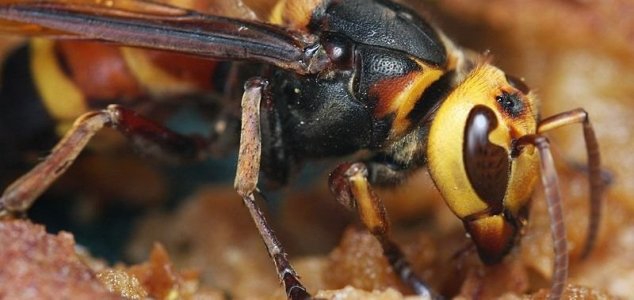
Man tames giant hornet and keeps it as a pet

Man tames giant hornet and keeps it as a pet

news-giant-hornet.jpg


The unnamed man from Japan allegedly ties string to the insect and takes it out for regular walks.

Measuring up to 6cm in length the giant Japanese hornet is one of the largest and deadliest insects in the world. In its native Japan these huge wasp-like creatures claim 40 lives on average every year and are considered the second most dangerous species in the country next to humans.

None of these facts however seem to have stopped one man in Japan from keeping one of them as a pet after he claimed to have caught it in a butterfly net and removed its sting and poison sacs.

Eyebrows were raised across the Internet this week when a series of photographs posted to the man's Twitter account appeared to show him taking the venomous insect for a walk on the streets of Tokyo using a small piece of string tied around its abdomen.

"He does bite occasionally but it doesn't really hurt," he wrote.

The story has since gone viral and social media has been abuzz with efforts to determine whether or not the story is genuine. Some Internet users have speculated that the images have been faked as part of a prank while others have suggested that it could be some sort of viral marketing exercise.

So far however the authenticity of the story has managed to remain something of a mystery.

 
Back
Top Bottom